
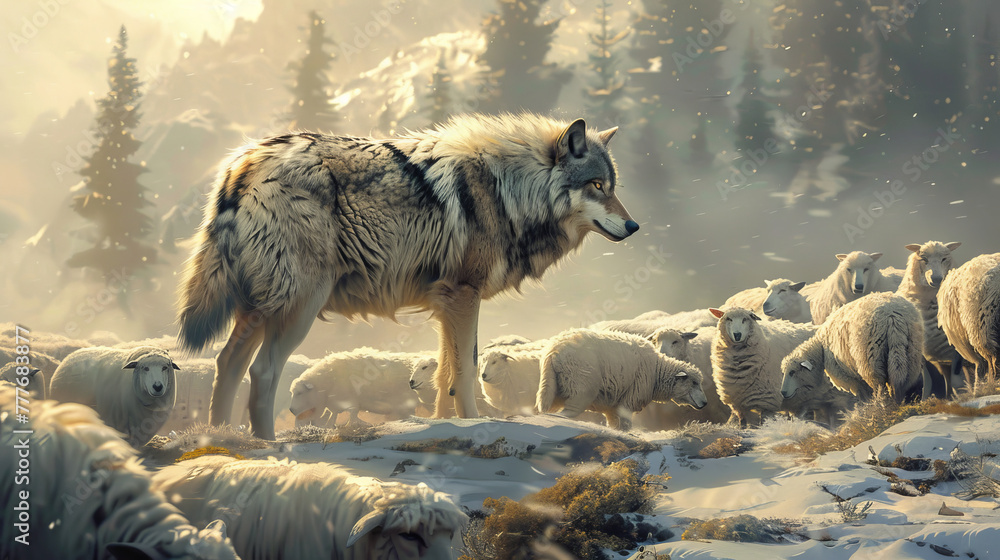
18 Aug Are You A Wolf Or A Sheep?
The Wolf, the Eagle, and the Sheep: What Does It Have to Do with Sales?
In the 2001 movie Training Day, the lead character, Alonzo Harris, a Los Angeles police officer played by Denzel Washington, makes these memorable statements:
“You got to decide whether you’re a wolf… or a sheep”
“A wolf doesn’t concern himself with the opinion of sheep.”
Although the character who delivers the line is hardly a model of integrity, the quote itself has an interesting message about confidence, independence, and conviction.
The basic idea is that people who are confident in their abilities and committed to a particular mission should not allow the opinions of others to distract them from achieving their objectives. There will always be people who question our decisions, criticize our approach, or simply do not understand what we are trying to accomplish. If we allow every negative opinion to influence us, it becomes difficult to move forward.
Confidence does not mean ignoring everyone. Quite the opposite. Successful people listen carefully, consider different perspectives, and then make their own decisions. They have enough confidence in themselves to distinguish between constructive criticism and unnecessary negativity.
That brings me to wolves, eagles, and sheep—and, eventually, sales.
Wolves
Wolves are highly intelligent and social animals. Unlike many predators that hunt alone, wolves generally operate in packs. A coordinated pack can pursue and bring down prey considerably larger and stronger than an individual wolf could handle.
A wolf pack communicates, coordinates its efforts, and works toward a common objective. Each wolf may have a different role, but the success of the hunt depends on the group working together.
There is an important lesson here: collaboration can create strength that an individual cannot achieve alone.
Eagles
Eagles represent something very different.
They are often portrayed as independent hunters, surveying their surroundings from above and then acting decisively when they identify an opportunity. They don’t need a pack to validate their decisions. They rely on their own vision, judgment, and ability to execute.
That reminds me of many of the best salespeople I have known.
The most successful sales pros tend to be independent thinkers. They don’t need someone standing over them telling them who to call, what to say, or how to manage every opportunity. They develop their own strategies, establish relationships, identify opportunities, and take responsibility for their results.
They are comfortable operating independently.
In fact, I have often found that the more successful a sales pro becomes, the less supervision they require.
And Then There Are Sheep
Sheep are herd animals. They feel safer when they are part of a group, and they generally follow the herd or its leaders. They are not predators; they are grazing animals that feed primarily on grasses and other vegetation.
There is a lesson here, too—but it is not necessarily a flattering one for sales pros.
A sales pro who simply follows everyone else, avoids making independent decisions, waits for instructions, and accepts the status quo without question is unlikely to become a top performer.
Sales is not a spectator sport.
You cannot consistently exceed quota by simply doing what everyone else is doing.
So, How Does This Apply to Sales?
This is where the analogy gets interesting.
I have found that many of the best sales pros prefer to operate like eagles. They are independent, self-motivated, competitive, and confident in their ability to make decisions. Give them a challenging objective and the freedom to pursue it, and they will often outperform expectations.
Sales managers, however, sometimes want those same salespeople to behave more like wolves.
And I understand why.
A sales organization is a team. Managers want their people sharing information, collaborating on opportunities, helping one another, introducing colleagues to prospects, and using the collective knowledge of the organization to win business.
There is tremendous value in that.
But there is a potential problem.
Sometimes eagles resist basic company rules and processes. In my book Above Quota Sales Management, I discuss the pros and cons of sales “cowboys”—men or women who often rank among the most productive sales pros, yet can often create problems that outweigh their revenue contributions.1
But, you don’t want to turn your eagles into sheep in the process.
The objective should not be to eliminate the salesperson’s independence. It should be to combine individual initiative with organizational teamwork.
The best salespeople should be able to hunt like eagles and collaborate like wolves.
They should be independent enough to recognize an opportunity before everyone else sees it, confident enough to pursue it without constant supervision, and disciplined enough to develop their own strategy.
But when the opportunity requires additional expertise, they should also be willing to bring in other members of the organization and work together to win the business.
Don’t Confuse Independence with Isolation
There is an important distinction between being independent and being isolated.
A sales pro who says, “I don’t need anyone’s help,” may be demonstrating confidence—or arrogance.
The best sales pros know when they can handle something themselves and when bringing in another person will increase their chances of winning.
That might mean involving a technical expert, executive sponsor, product specialist, implementation expert, or sales manager. It might mean asking a colleague who has sold successfully to a similar customer to share what worked.
The sales pro is in charge of the opportunity, but understands that sometimes the best way to win is to use the entire team.
What About the Sheep?
Every sales organization has them.
They wait for leads.
They wait for marketing.
They wait for the manager.
They wait for the customer to call.
They follow the same prospecting strategy everyone else uses because it is comfortable.
They see their competitors doing something and immediately copy it.
And when something goes wrong, they have an explanation for why it wasn’t their fault.
That isn’t salesmanship. That’s following the herd.
Great salespeople don’t wait for the herd to move.
They identify where they want to go and start moving.
The Best Sales Organizations Need All Three—But Not Equally
The wolf teaches us the value of teamwork.
The eagle teaches us the value of independence, vision, and decisive action.
The sheep provides a useful reminder of what happens when we surrender our judgment and simply follow the herd.
For salespeople, I believe the ideal combination is straightforward:
Think like an eagle.
Work like a wolf.
Never sell like a sheep.
Have the confidence to make your own decisions. Have the humility to recognize when teamwork will improve the outcome. And, most importantly, never allow fear of criticism, rejection, or doing something differently to prevent you from pursuing an opportunity.
The greatest salespeople I have known weren’t successful because they followed the herd.
They were successful because they were willing to see what others didn’t see, do what others wouldn’t do, and take responsibility for the result.
1 Steven Weinberg, Above Quota Sales Management, Armin Lear Press (Estes Park, CO, 2024), p. 171-174.